Displaying 61 - 70 of 194
Final Report of the UNODA Project to Identify Lessons Learned from the OPCW-UN Joint Investigative Mechanism
When the OPCW-UN Joint Investigative Mechanism (JIM) was established by Security Council resolution 2235 in August 2015, it was given the mandate to identify, to the greatest extent feasible, the perpetrators of the use of chemicals as weapons in the Syrian Arab Republic. The JIM’s mandate for attribution of responsibility was a unique undertaking in the context of past efforts by both the United Nations and the OPCW to investigate allegations of the use of chemical weapons. Accordingly, after the expiration of the JIM’s mandate in 2017, there was interest in conducting a lessons-learned exercise to distill the lessons from the experience of the JIM, as is frequent practice within the United Nations after the conclusions of missions and programmes. UNODA was fortunate to receive support for a lessons-learned project from the Governments of Canada and Switzerland, whose generous financial contributions made the project possible. UNODA is pleased to share the final report of the JIM …
Oct 6, 2020
Conventional Ammunition Management: Developments and Challenges from COVID-19
The COVID-19 pandemic is an unprecedented global challenge with as yet unknown social, economic and political consequences, both short- and long-term. This includes a potential impact on the field of disarmament in general and the conventional ammunition management in particular. This paper offers a preliminary analysis of the effects of COVID-19 on the ammunition management sector in the spring of 2020. It raises key issues related to the risks associated with conventional ammunition through the implementation of relevant control and management measures. The paper argues that shifts in national priorities and reduced resources may affect overall international disarmament efforts by undermining the management of conventional ammunition, and potentially enhance the risks of accidental explosions and diversion. Ammunition management needs to remain a priority during and after COVID-19. Implementing effective and sustainable ammunition management policies and practices will allow states …
Aug 26, 2020
The Militarization of Artificial Intelligence
Artificial Intelligence (AI) has the potential to improve the health and well-being of individuals, communities, and states, and help meet the UN’s Sustainable Development Goals. However, certain uses of AI could also undermine international peace and security by raising concerns about safety and security of the technology, accelerating the pace of armed conflicts, or loosening human control over the means of war. In 2019, the United Nations Office for Disarmament Affairs, the Stanley Center and the Stimson Center partnered in a workshop and series of papers to facilitate a multistakeholder discussion among experts from Member States, industry, academia, and research institutions, with the aim of building understanding about the peace and security implications of AI. This publication captures that conversation and shares assessments of the topic from US, Chinese, and Russian perspectives. It is intended to provide a starting point for more robust dialogues among diverse communities …
Jun 3, 2020
Disarmament Resolutions and Decisions of the Seventy-fourth Session of the United Nations General Assembly
Compiles the disarmament resolutions and decisions of the seventy-fourth session of the General Assembly, the voting patterns in the General Assembly and the First Committee report and dates of their adoption. Contains a snapshot of votes by thematic cluster of resolution numbers, titles and votes in the seventy-fourth session of the General Assembly and in the First Committee. …
Apr 30, 2020
Rethinking Unconstrained Military Spending
This publication addresses the issue of military spending from various angles by examining the impact of military expenditures on international security; the relationship between military spending and the achievement of the 2030 Agenda for Sustainable Development; the importance of gender perspectives in rethinking unconstrained military spending; and lessons learned from economic conversion movements. It has been published in support of the Sustainable Development Goals and the Secretary-General’s Agenda for Disarmament to promote renewed research and analysis on the relationship between military spending and economic and social …
Apr 1, 2020
The Anti-Personnel Mine Ban Convention: 20 Years of Saving Lives and Preventing Indiscriminate Harm
This publication describes the achievements and shortfalls of the first twenty years of the Convention on the Prohibition of the Use, Stockpiling, Production and Transfer of Anti-Personnel Mines and on Their Destruction, which entered into force on 1 March 1999. Published with the aim of bringing together diverse perspectives on this key instrument of humanitarian disarmament, the paper was written by pioneers and luminaries of the movement that helped achieve the Convention and that committed themselves towards realizing the Convention’s full implementation. Each chapter contains discussions of an element of the …
Nov 1, 2019
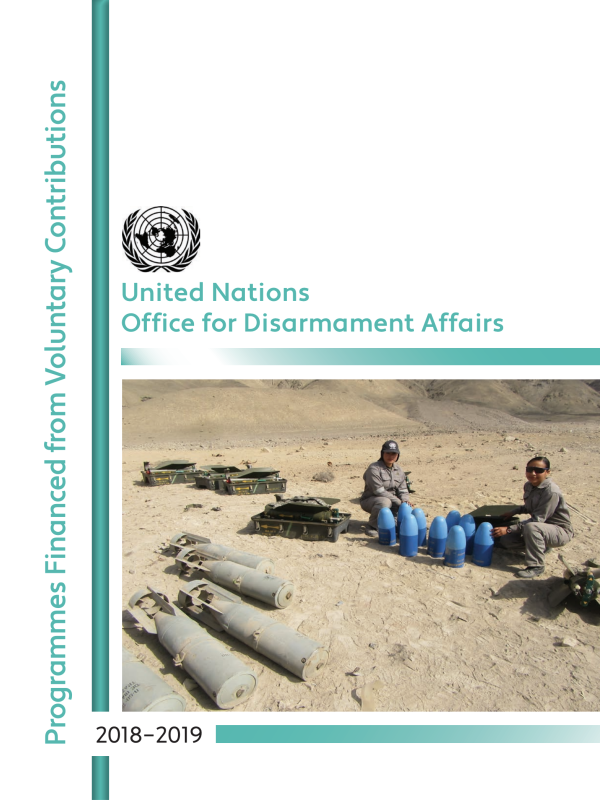
This report illustrates how the United Nations Office for Disarmament Affairs has been able to achieve concrete results through partnerships with its donors, and how essential such support is in attaining important disarmament goals. …
Oct 31, 2019
United Nations Efforts to Reduce Military Expenditures: A Historical Overview
This publication provides a historical survey of efforts within the United Nations to reduce military spending. Starting with the Charter, which envisages the maintenance of international peace and security with the least diversion of resources to arms, reducing military spending was actively pursued throughout the cold war period as a distinct objective within broader negotiations on general and complete disarmament. Separate and distinct efforts to pursue reductions in the military expenditures of the major Powers gave rise to a parallel effort to develop means for sharing information and comparing military spending between States. The resulting mechanism, the United Nations Report on Military Expenditures, continues to function as a means for promoting transparency on military matters. The reduction of military spending was also examined over a period of decades as a means of obtaining resources needed to meet the development objectives of the Organization. The 2030 Agenda for …
Oct 1, 2019
Summarizes developments and trends in 2018 on key issues of multilateral consideration at the international and regional levels. Reviews the activity of the General Assembly, the Conference on Disarmament and the Disarmament Commission. Contains a timeline that highlights events in multilateral disarmament in 2018. Has a foreword written by the High Representative for Disarmament Affairs. …
Sep 30, 2019
Disarmament Resolutions and Decisions of the Seventy-third Session of the United Nations General Assembly
Compiles the disarmament resolutions and decisions of the seventy-third session of the General Assembly, the voting patterns in the General Assembly and the First Committee report and dates of their adoption. Contains a snapshot of votes by thematic cluster of resolution numbers, titles and votes in the seventy-third session of the General Assembly and in the First Committee. …
Apr 30, 2019