When the OPCW-UN Joint Investigative Mechanism (JIM) was established by Security Council resolution 2235 in August 2015, it was given the mandate to identify, to the greatest extent feasible, the perpetrators of the use of chemicals as weapons in the Syrian Arab Republic. The JIM’s mandate for attribution of responsibility was a unique undertaking in the context of past efforts by both the United Nations and the OPCW to investigate allegations of the use of chemical weapons.
Accordingly, after the expiration of the JIM’s mandate in 2017, there was interest in conducting a lessons-learned exercise to distill the lessons from the experience of the JIM, as is frequent practice within the United Nations after the conclusions of missions and programmes. UNODA was fortunate to receive support for a lessons-learned project from the Governments of Canada and Switzerland, whose generous financial contributions made the project possible.
UNODA is pleased to share the final report of the JIM lessons-learned project. The project provided an opportunity to reflect on the recommendations that could benefit future such investigations and help to enhance common understanding of what can be done to establish an effective and credible mechanism to identify those responsible for the use of chemical weapons.
While any future such mechanism would need – and should be enabled to the fullest extent – to make its own decisions on the topics addressed in this report based on the requirements of its mandate and individual case information, UNODA hopes that the lessons and recommendations presented in this report could serve as helpful guidance. UNODA also hopes that these recommendations could serve to help the international community confront the challenges to international peace and security posed by the use of chemical weapons and to restore respect for the global norm against chemical weapons use.
Dear Colleagues,
We are very pleased to share the eleventh issue of the UNSGM newsletter, which covers the activities organized in support of the UNSGM for the second half of 2025. The UNSGM team at UNODA worked diligently to maintain the pace of activities in 2025. We are pleased to provide more details on these activities below, as well as an update on staffing for the UNSGM team to ensure the continued high standard of support going forward.
Dear Colleagues,
We are very pleased to share the tenth issue of the UNSGM newsletter. 2025 has proven to be another busy year for the UNSGM team. The first half of the year has already seen several training courses, a regional outreach workshop, and many other activities to strengthen the UNSGM – more details on which can be found in this issue.
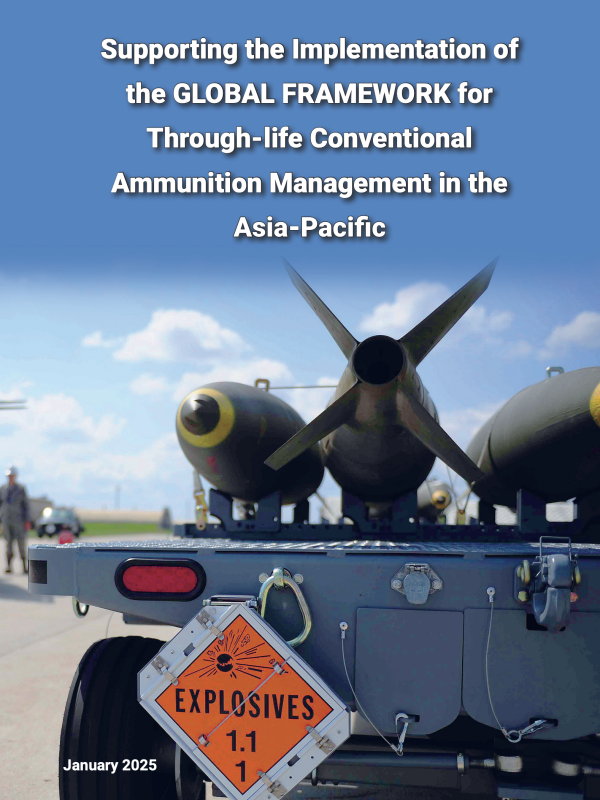
This briefing paper provides an overview of the Global Framework for Through-life Conventional Ammunition Management (GFA) and explores its relevance and implications for the Asia-Pacific region. Building upon discussions held during the Informal Regional Meeting in support of the GFA—organized by UNRCPD on 4–5 December 2024 in Kathmandu, Nepal—and based on desk research and a series of consultations, the paper identifies regional opportunities and challenges for GFA implementation. The paper begins with a brief history of the process leading to the elaboration and adoption of the GFA.