Displaying 51 - 60 of 194
Disarmament Resolutions and Decisions of the Seventy-fifth Session of the United Nations General Assembly
Compiles the disarmament resolutions and decisions of the seventy-fifth session of the General Assembly, the voting patterns in the General Assembly and the First Committee report and dates of their adoption. Contains a snapshot of votes by thematic cluster of resolution numbers, titles and votes in the seventy-fifth session of the General Assembly and in the First Committee. …
Apr 30, 2021
UNODA Strategic Plan
The UNODA Strategic Plan 2021-2025 provides an overarching vision for how the Office will contribute to the goal of general and complete disarmament, setting out UNODA’s core priorities over the next five years. …
Feb 22, 2021
UNSGM-Newsletter
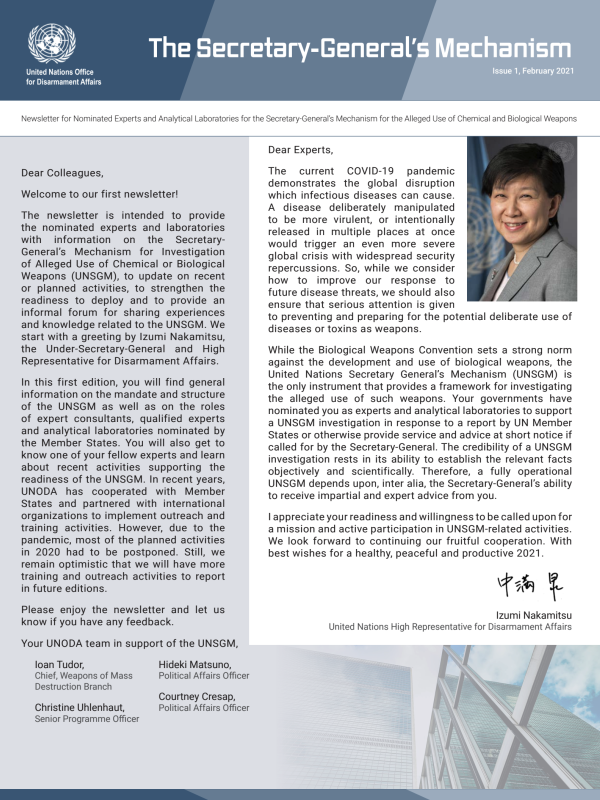
Dear Colleagues, Welcome to our first newsletter! The newsletter is intended to provide the nominated experts and laboratories with information on the SecretaryGeneral’s Mechanism for Investigation of Alleged Use of Chemical or Biological Weapons (UNSGM), to update on recent or planned activities, to strengthen the readiness to deploy and to provide an informal forum for sharing experiences and knowledge related to the UNSGM. We start with a greeting by Izumi Nakamitsu, the Under-Secretary-General and High Representative for Disarmament Affairs. In this first edition, you will find general information on the mandate and structure of the UNSGM as well as on the roles of expert consultants, qualified experts and analytical laboratories nominated by the Member States. You will also get to know one of your fellow experts and learn about recent activities supporting the readiness of the UNSGM. In recent years, UNODA has cooperated with Member States and partnered with international …
Feb 1, 2021
United Nations Programme of Fellowships on Disarmament at 40
The United Nations Disarmament Fellowship Programme is the result of one of the most successful decisions by the First Special Session of the General Assembly devoted to Disarmament. Initiated by Nigeria in order to promote expertise in disarmament in more Member States, particularly in the developing countries, the 40-year old programme has developed into a true institution in the field of disarmament education and capacity-building. To date, it has successfully trained over 1,000 Disarmament Fellows from 170 States, many of whom now hold national or international positions of responsibility in the field of disarmament. Balancing in-depth knowledge with practical experience, the comprehensive 10-week-long annual programme provides the Fellows with the unique opportunity to discuss achievements and challenges in the field of disarmament and arms control with hibakusha, senior diplomats and officials, as well as representatives of academia, think tanks and non-governmental …
Dec 1, 2020
Report of the Secretary-General on current developments in science and technology and their potential impact on international security and disarmament efforts
This report was prepared pursuant to General Assembly resolution 74/35 . It provides an overview of recent scientific and technological developments relevant to the means and methods of warfare. It examines their broader impacts on security and disarmament and highlights the implications for efforts to limit the humanitarian consequences of armed conflict. The report also describes the relevant intergovernmental processes in which these developments are being addressed. The Office for Disarmament Affairs prepared this enhanced version of the report as part of its efforts to implement Action 24 of the Secretary-General’s Agenda for Disarmament, Securing our Common Future, on raising awareness on the implications of new weapon …
Nov 30, 2020
Navigating Disarmament Education
With 37 years of experience in coordinating people-to-people exchange via voyages on a passenger ship, the non-governmental organization Peace Boat has implemented various disarmament education programmes over the past decades. As a steering group member organization of the International Campaign to Abolish Nuclear Weapons (ICAN), Peace Boat has been particularly active in engaging hibakusha—atomic-bomb survivors of Hiroshima and Nagasaki. Together with hibakusha, Peace Boat has worked with youth from all backgrounds to think about why disarmament is important and how it works. This publication introduces Peace Boat’s methodology for disarmament education, which directly stems from lessons learned through implementation of various disarmament education programmes. It also discusses how disarmament education should be implemented in relation to the UN Sustainable Development Goals (SDGs) and how digital technologies can be leveraged to provide a fruitful experience for …
Nov 2, 2020
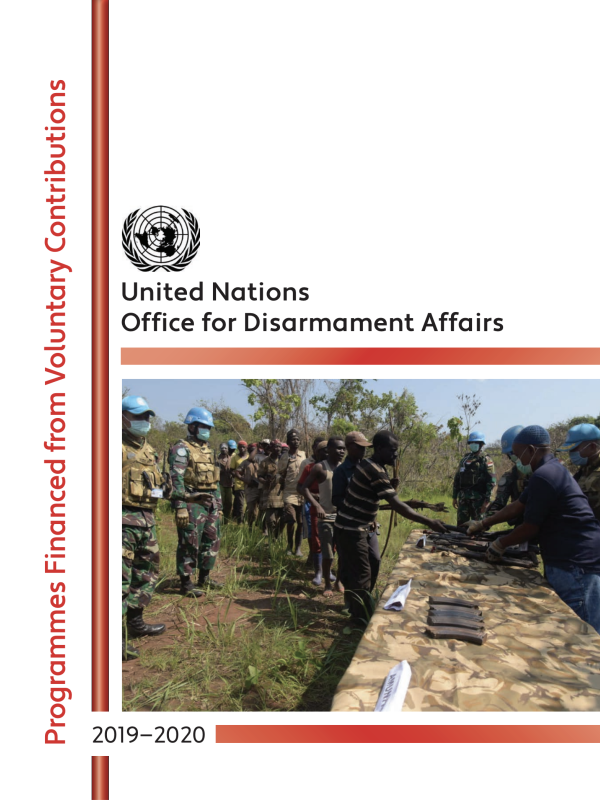
This report illustrates how the United Nations Office for Disarmament Affairs has been able to achieve concrete results through partnerships with its donors, and how essential such support is in attaining important disarmament goals. …
Oct 31, 2020
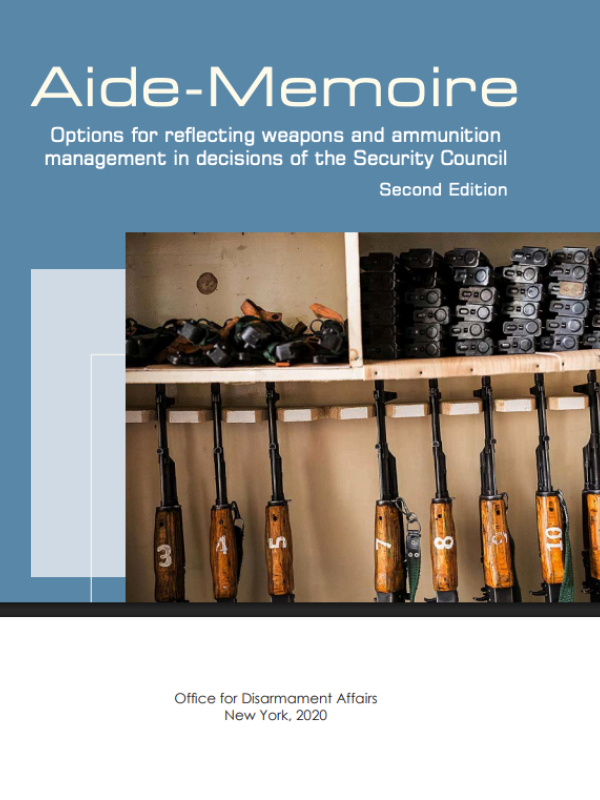
Aide-Memoire: Options for reflecting weapons and ammunition management in decisions of the Security Council
This is the Second Edition of the Aide-Memoire that was originally published in 2018. The content has been updated to reflect the evolution in the Security Council’s practice in addressing weapons and ammunition-related issues from the end of the 1990s through to August 2020. This Second Edition includes a new section highlighting recommendations made by the Secretary-General to support the mainstreaming of weapons and ammunition-related matters in the work of the Security Council derived from previous reports to the Security Council on small arms and light weapons. The main body of the Aide-Memoire (and its supporting Annex 1) is based on a review of more than 650 UN Security Council country-/region-specific and thematic resolutions, and relevant presidential statements issued since the end of the 1990s. A 30-year time frame was used to ensure a broad pool of language options. This time period also corresponds to the establishment of several of the main United Nations peace …
Oct 30, 2020
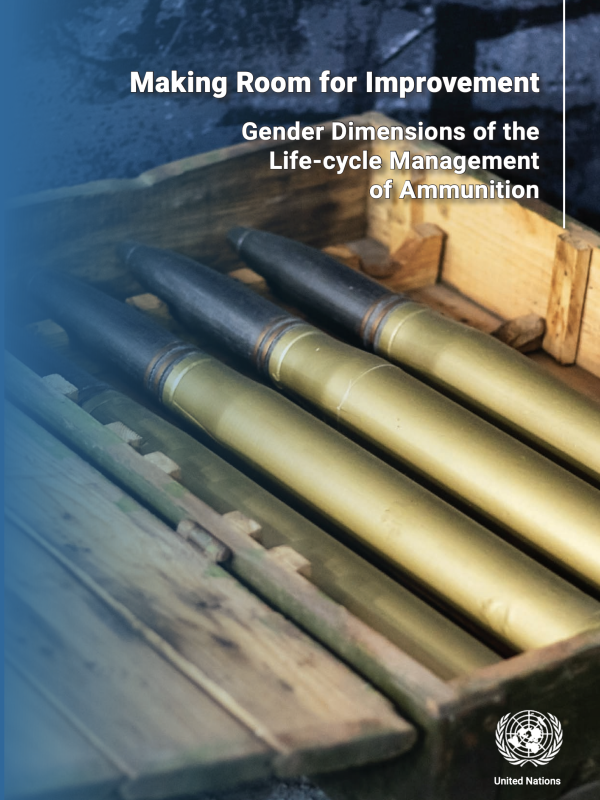
Making Room for Improvement: Gender Dimensions of the Life-cycle Management of Ammunition
In recent years, the international arms control agenda has become more aligned with that of sustainable development and the Women, Peace, and Security Agenda. As a result, two important synergies have emerged. The first is a focus on disaggregating, assessing, and addressing the various ways in which arms and ammunition impact different stakeholder groups through tools such as gender analysis and the sex disaggregation of data. The second is the need to gender mainstream relevant policies and procedures––that is, to institutionalize meaningful participation in all work processes and structures. The rationale for these approaches is that they will lead to control efforts that are more equitable for those who do the work and more effective and sustainable for beneficiaries. The UN Secretary-General first drew attention to the importance of these considerations in his Securing our Common Future: An Agenda for Disarmament in 2018, and subsequently in his 2019 Report on Small Arms and …
Oct 30, 2020
Summarizes developments and trends in 2019 on key issues of multilateral consideration at the international and regional levels. Reviews the activity of the General Assembly, the Conference on Disarmament and the Disarmament Commission. Contains a timeline that highlights events in multilateral disarmament in 2019. Has a foreword written by the High Representative for Disarmament Affairs. …
Oct 30, 2020