Displaying 31 - 40 of 194
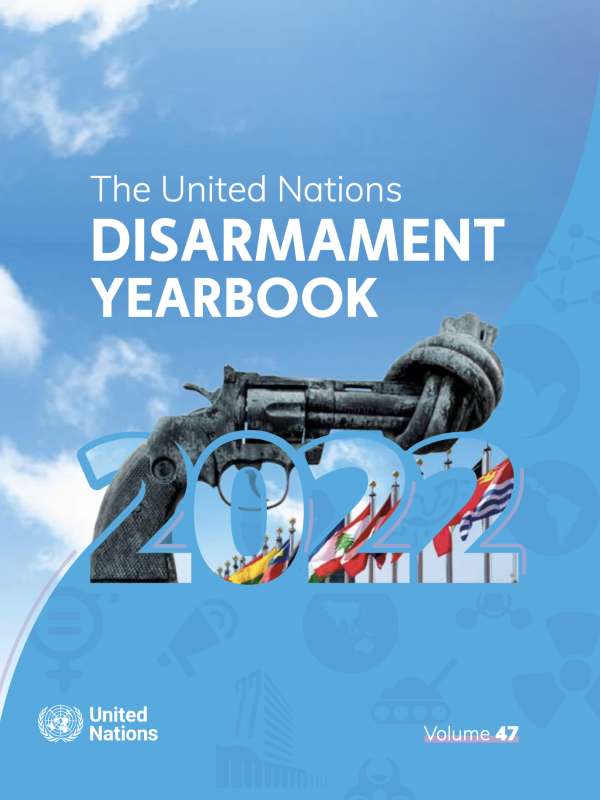
Concise reference tool on disarmament, non-proliferation and arms control issues Includes developments and trends , a convenient issue-oriented timeline and explanatory graphics and charts Annex on resolutions, status of treaties and other resources : a one-stop-shop to access recommended 2022 information materials, including publications and the following databases: Disarmament Resolutions and Decisions Database : texts, sponsors, voting patterns and other related information. Disarmament Treaties Database : status of multilateral regulation and disarmament agreements. User-friendly: Website version accessible on mobile devices and available in multiple languages through third-party machine translation (see how: Chrome | Safari). Official translations in the six official languages of the United Nations will be uploaded as they become available. Condensed and full Yearbook Advance and condensed version : Provides an easy-to-read overview of the publication earlier in the year. …
Jul 24, 2023
The United Nations and Disarmament amid COVID-19
Adaptation and Continuity
The COVID-19 outbreak posed an unprecedented challenge to intergovernmental disarmament institutions and processes. This publication offers an extensive review of relevant developments at the United Nations, particularly in the General Assembly and the Security Council, as well as in the disarmament machinery and other disarmament bodies and processes. After comparing the varying responses to the pandemic, the author considers whether the outbreak should serve as a catalyst for rethinking and changing multilateral working methods or rules of …
Jul 1, 2023
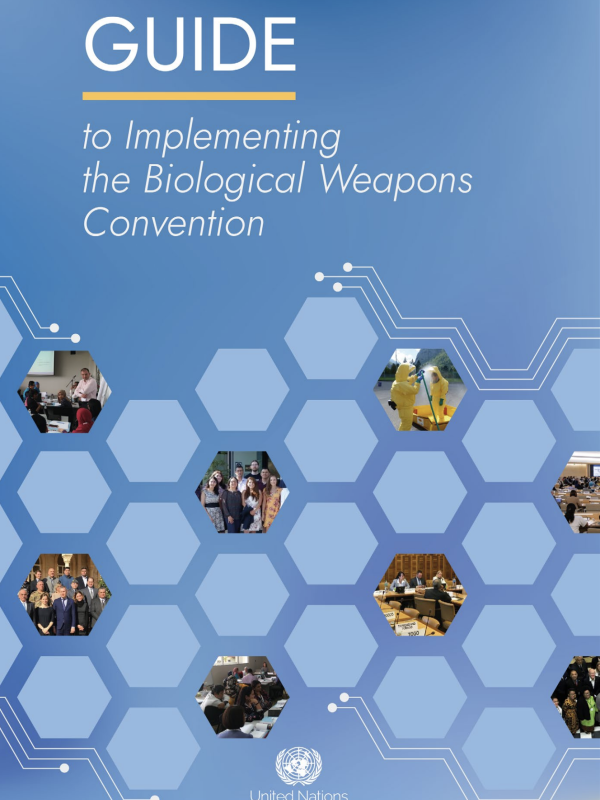
Guide to Implementing the Biological Weapons Convention
The Guide to Implementing the Biological Weapons Convention has been developed by the United Nations Office for Disarmament Affairs (UNODA), with the support of the European Union and Norway and the contributions of a wide range of BWC experts, to assist States Parties in their efforts to implement the Convention at the national level. The Guide is primarily intended to provide an overview of the national implementation process and obligations stemming from the BWC. Its primary audience is States Parties initiating or already engaged in the BWC implementation process or States Parties interested in assessing their implementing framework. The Guide outlines the types of legislative, regulatory and other measures that States Parties may consider developing and adopting in order to effectively implement the BWC. The Guide is available in all 6 UN official languages. Furthermore, in response to requests from Lusophone countries, the Guide is also available in …
May 16, 2023
The Global Reported Arms Trade: Transparency in Armaments Through the United Nations Register of Conventional Arms
A Guide to Assist National Points of Contact in Submitting Their National Reports
The United Nations Office for Disarmament Affairs is publishing this paper on the occasion of the thirtieth anniversary of the United Nations Register of Conventional Arms. It aims to provide guidance in support of Member State participation in the Register. The text includes an overview of the Register for reference by Governments and the interested public, as well as original material to guide national points of contact in preparing and submitting reports for the Register. The second part of the paper contains the report of the 2022 Group of Governmental Experts on the continuing operation of the …
Apr 1, 2023
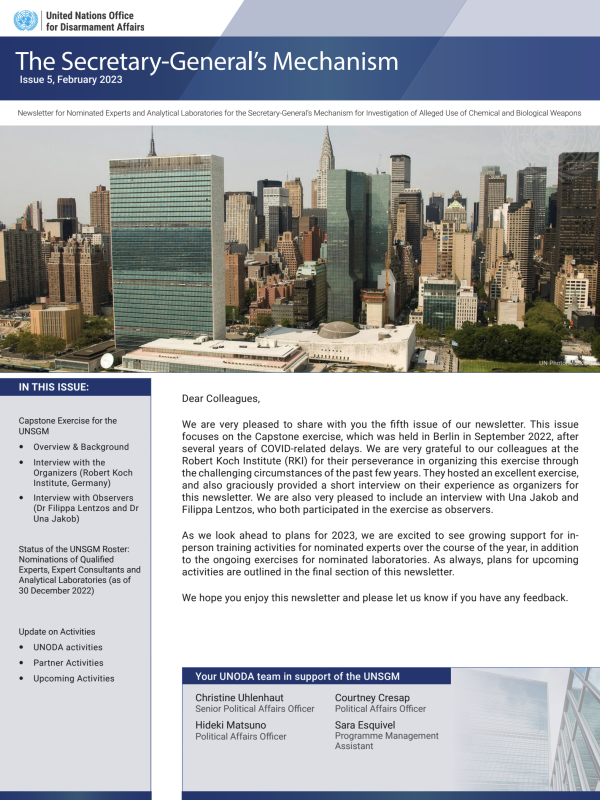
UNSGM-Newsletter
Dear Colleagues, We are very pleased to share with you the fifth issue of our newsletter. This issue focuses on the Capstone exercise, which was held in Berlin in September 2022, after several years of COVID-related delays. We are very grateful to our colleagues at the Robert Koch Institute (RKI) for their perseverance in organizing this exercise through the challenging circumstances of the past few years. They hosted an excellent exercise, and also graciously provided a short interview on their experience as organizers for this newsletter. We are also very pleased to include an interview with Una Jakob and Filippa Lentzos, who both participated in the exercise as observers. As we look ahead to plans for 2023, we are excited to see growing support for inperson training activities for nominated experts over the course of the year, in addition to the ongoing exercises for nominated laboratories. As always, plans for upcoming activities are outlined in the final section of this …
Feb 1, 2023
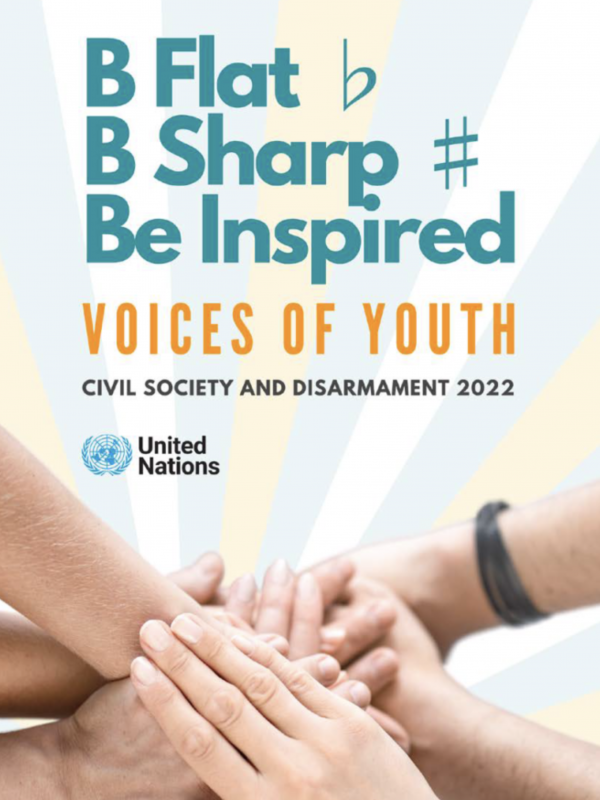
B Flat, B Sharp, Be Inspired: Voices of Youth
Launched in 2019, the #Youth4Disarmament (Y4D) initiative of the United Nations Office for Disarmament Affairs seeks to engage, educate and empower young people to facilitate their meaningful contribution to disarmament efforts. The “Spotlight Stories” section of the Y4D community website offers a space for young people to share – in their own voices and from their own perspectives – why the work of disarmament is critical to building peace and how they are helping push the field forward. This publication is a compilation of those stories, which reveal hope for a better future and show some of the diverse ways to pursue peace through disarmament in the twenty-first …
Dec 28, 2022
Disarmament Education Strategy
The UNODA Disarmament Education Strategy provides a common framework for the Office’s disarmament education efforts. It aims at enhancing coordination and coherence across various UNODA educational activities, diversifying partnerships and audiences reached, and fostering more sustainable and impactful initiatives. …
Dec 5, 2022
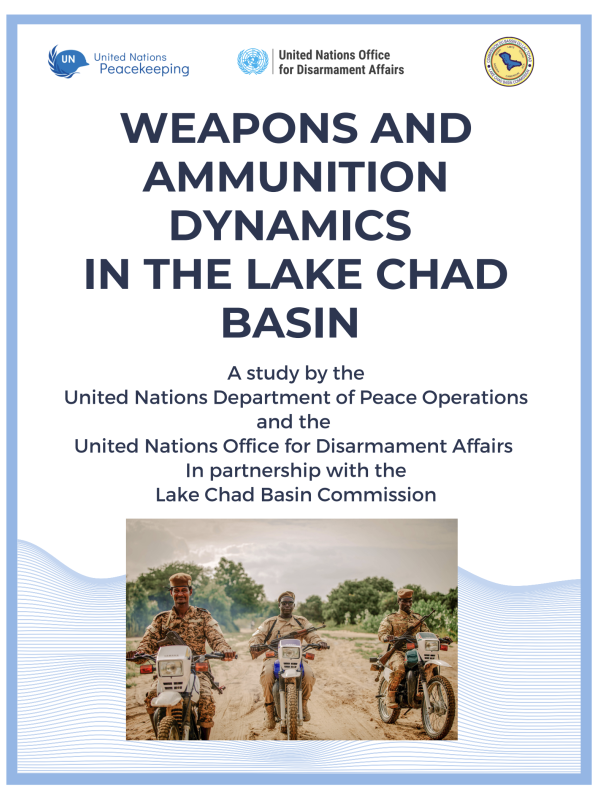
Weapons and Ammunition Dynamics in the Lake Chad Basin
The study was developed by the Department of Peace Operations (DPO) and the Office for Disarmament Affairs (ODA) in partnership with the Lake Chad Basin Commission (LCBC), and was made possible through the generous contribution of the Government of Germany. The Lake Chad Basin region has been affected by illicit arms flows representing one of the primary conflict drivers. As part of an integrated DDR process, the implementation of transitional weapons and ammunition management (TWAM) can serve to reduce the capacity of individuals and groups to engage in armed violence and conflict. To this end, the study presents key findings as well as recommendations to support national, regional and international arms control and DDR policymakers and practitioners in the design and implementation of evidence-based, efficient and gender-sensitive WAM and DDR initiatives in line with good practices. The report analyzes (i) political and security aspects, (ii) current weapons and ammunition dynamics, …
Oct 31, 2022
Summarizes developments and trends in 2021 on key issues of multilateral consideration at the international and regional levels. Reviews the activity of the General Assembly, the Conference on Disarmament and the Disarmament Commission. Contains a timeline that highlights events in multilateral disarmament in 2021. Has a foreword written by the High Representative for Disarmament Affairs. …
Oct 30, 2022
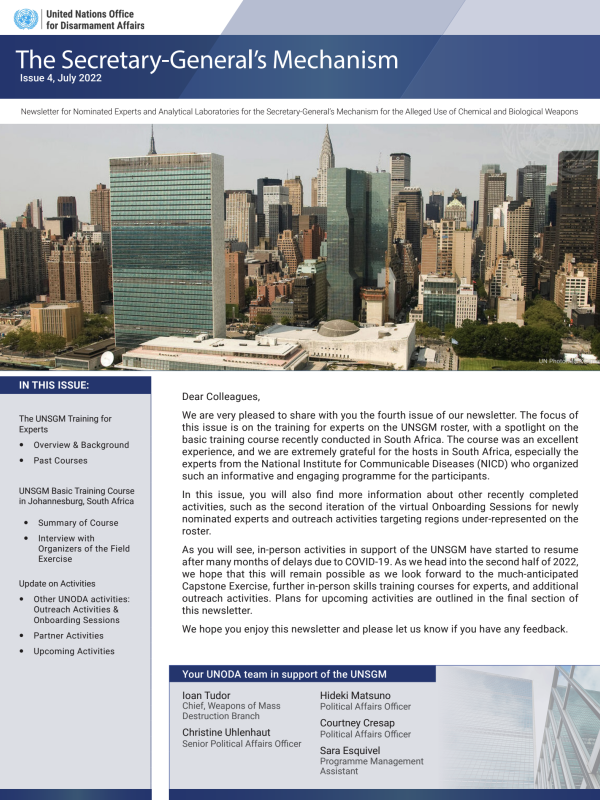
UNSGM-Newsletter
Dear Colleagues, We are very pleased to share with you the fourth issue of our newsletter. The focus of this issue is on the training for experts on the UNSGM roster, with a spotlight on the basic training course recently conducted in South Africa. The course was an excellent experience, and we are extremely grateful for the hosts in South Africa, especially the experts from the National Institute for Communicable Diseases (NICD) who organized such an informative and engaging programme for the participants. In this issue, you will also find more information about other recently completed activities, such as the second iteration of the virtual Onboarding Sessions for newly nominated experts and outreach activities targeting regions under-represented on the roster. As you will see, in-person activities in support of the UNSGM have started to resume after many months of delays due to COVID-19. As we head into the second half of 2022, we hope that this will remain possible as we look …
Jul 1, 2022