Displaying 1 - 10 of 194
Revisiting consensus in multilateral disarmament negotiations
Trends, challenges and the way forward
This paper examines the evolving role of consensus in multilateral disarmament negotiations from the tenth special session of the General Assembly (1978) to the present day. It aims to support Member States in considering how to balance progress on disarmament with the legitimacy associated with consensus-based outcomes. Rather than offering a legal definition or interpretation of consensus, the authors reflect upon historical examples of its practical application, particularly in the areas of nuclear disarmament and conventional arms. The case studies presented do not imply approval or disapproval of positions taken by …
Feb 27, 2026
UNSGM-Newsletter
Dear Colleagues, We are very pleased to share the eleventh issue of the UNSGM newsletter, which covers the activities organized in support of the UNSGM for the second half of 2025. The UNSGM team at UNODA worked diligently to maintain the pace of activities in 2025. We are pleased to provide more details on these activities below, as well as an update on staffing for the UNSGM team to ensure the continued high standard of support going forward. …
Jan 29, 2026
The Biological Weapons Convention at 50
Perspectives from Asia and the Pacific
The Biological Weapons Convention (BWC) stands as a landmark achievement in the history of disarmament. For half a century, it has embodied the international community’s collective determination to ensure that advances in life sciences are never turned to destructive uses. As we commemorate the fiftieth anniversary of its entry into force in 2025, the Convention continues to serve as both a moral compass and a legal foundation for global efforts to prevent the development, production, and use of biological …
Jan 19, 2026
Disarming with Story
How Survivor Stories Shape Nuclear Disarmament Work
The Office for Disarmament Affairs publishes the series entitled "Civil Society and Disarmament " within the context of the General Assembly resolutions on the United Nations Disarmament Information Programme and the United Nations Study on Disarmament and Non-proliferation Education. The publication provides a forum for the views of civil society in order to further an informed debate on topical issues of arms limitation, disarmament and security. …
Oct 28, 2025
For nearly five decades, this publication has provided an objective record of developments in multilateral disarmament, non-proliferation and arms control. Now in its forty-ninth volume, the Yearbook continues its vital mission to document efforts by the United Nations, Member States and other stakeholders to advance international peace and security through disarmament initiatives and arms control measures. Its enhanced preview edition, issued earlier in the year, equips policymakers and the public with a timely and authoritative overview of the most salient developments in this …
Sep 30, 2025
Handbook on Responsible Innovation in AI for International Peace and Security
The objective of this handbook is to compile basic knowledge and means for artificial intelligence (AI) practitioners to understand, evaluate and mitigate, in the research and innovation process, the risks of the diversion and misuse of civilian AI technology by irresponsible actors. The handbook shows why and how decisions around the development and diffusion of research and innovation can impact risks of misuse, and in turn generate risks or even opportunities for international peace and security. …
Jul 31, 2025
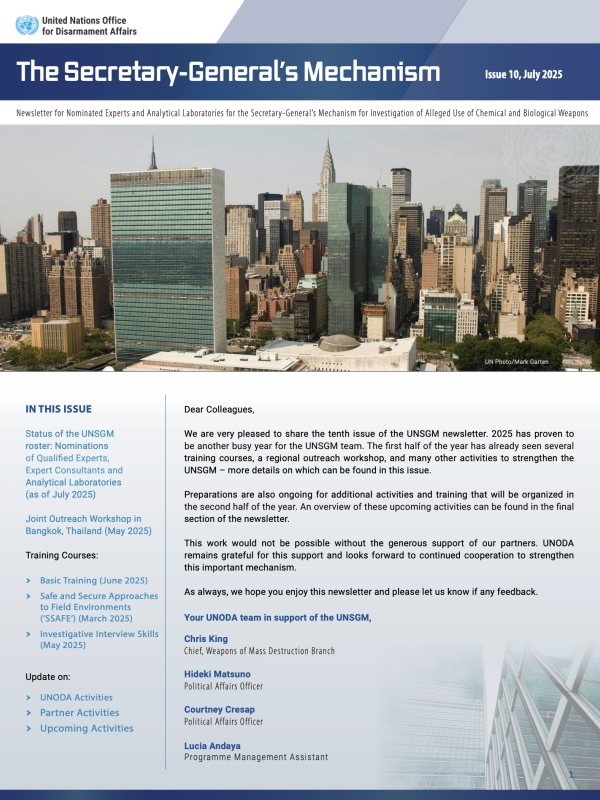
UNSGM-Newsletter
Dear Colleagues, We are very pleased to share the tenth issue of the UNSGM newsletter. 2025 has proven to be another busy year for the UNSGM team. The first half of the year has already seen several training courses, a regional outreach workshop, and many other activities to strengthen the UNSGM – more details on which can be found in this issue. …
Jul 31, 2025
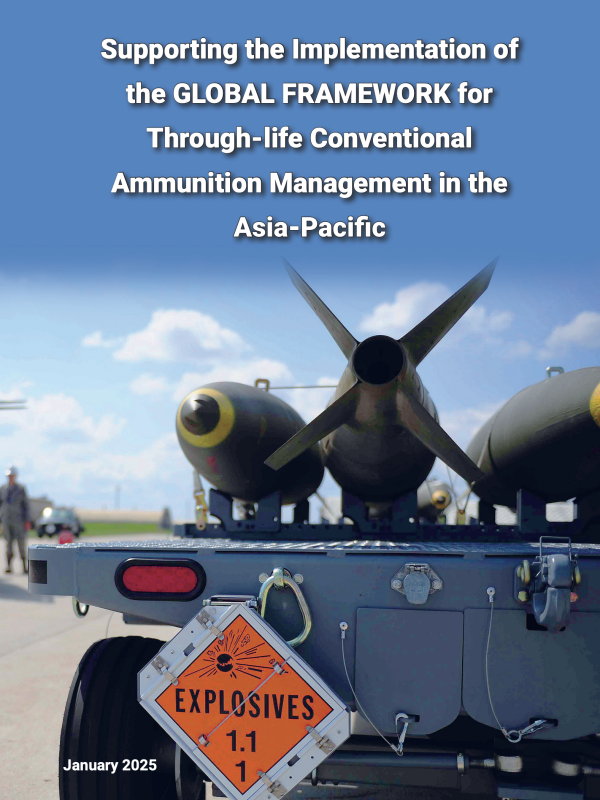
Supporting the Implementation of the Global Framework for Through-life Conventional Ammunition Management in the Asia-Pacific
This briefing paper provides an overview of the Global Framework for Through-life Conventional Ammunition Management (GFA) and explores its relevance and implications for the Asia-Pacific region. Building upon discussions held during the Informal Regional Meeting in support of the GFA—organized by UNRCPD on 4–5 December 2024 in Kathmandu, Nepal—and based on desk research and a series of consultations, the paper identifies regional opportunities and challenges for GFA implementation. The paper begins with a brief history of the process leading to the elaboration and adoption of the GFA. It then outlines the 15 objectives with reference to the rationale provided in the Annex of the Framework. The paper also examines synergies with other international and regional arms control instruments. Finally, it presents key considerations for Asia-Pacific states, highlighting specific regional issues, and offers recommendations to support effective and sustainable implementation of the GFA in the …
Jun 16, 2025
The Biological Weapons Convention
An Introduction
First published in 2017 , the updated publication ‘The Biological Weapons Convention: An Introduction’ provides its readers with a comprehensive overview of the Biological Weapons Convention. The publication covers the history of the negotiations and the current state of implementation of the Convention. It also explains the significance of the Convention in the modern world. …
May 30, 2025
The Impacts of the Availability of Firearms in Central America
Armed violence, the subject of this publication, represents one of the most damaging security problems for Central America’s inhabitants. Violent deaths caused by firearms in countries in the region comprise between 70 and 90 per cent. Regulatory frameworks in different countries seem to be inadequate in controlling firearms used in acts of violence. This study aims to address the lack of information and analysis on matters such as the role of Governments in restraining violence and controlling the availability of firearms, the impact of transnational organized crime, and the porosity of borders and corruption. It also concludes that armed violence does not affect all members of society, such as women and youth, in the same …
Apr 8, 2025