Displaying 101 - 110 of 194
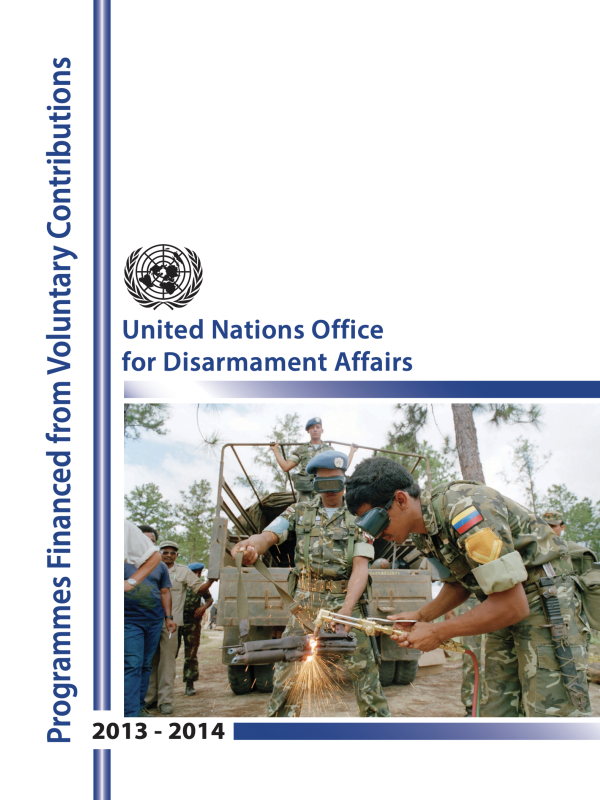
This report illustrates how the United Nations Office for Disarmament Affairs has been able to achieve concrete results though partnerships with its donors, and how essential such support is in attaining important disarmament goals. …
Sep 30, 2015
Summarizes developments and trends in 2014 on key issues of multilateral consideration at the international and regional levels. Reviews the activity of the General Assembly, the Conference on Disarmament and the Disarmament Commission. Contains a timeline that highlights events in multilateral disarmament in 2014. Has a foreword written by the Acting High Representative for Disarmament Affairs. …
Sep 30, 2015
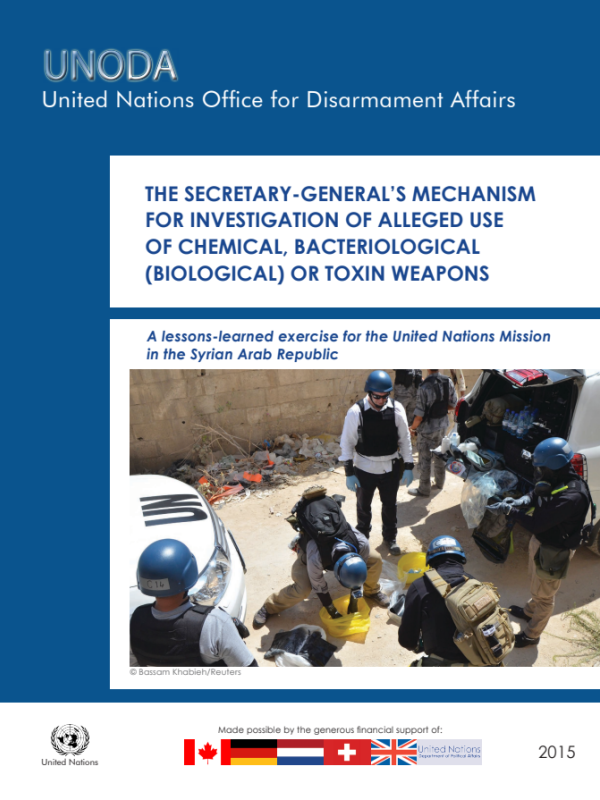
The Secretary-General's Mechanism for Investigation of Alleged Use of Chemical, Bacteriological (Biological) or Toxin Weapons
A lessons-learned exercise for the United Nations Mission in the Syrian Arab Republic
In December 2013, upon completion of the UN Mission to Investigate Allegations of the Use of Chemical Weapons in the Syrian Arab Republic, the Secretary-General called for a lessons-learned process to strengthen preparedness in order to enhance the effective application of the Secretary-General’s Mechanism (SGM) and its Guidelines in future investigations. As a result, UNODA launched a comprehensive lessons-learned exercise with generous financial support from interested donors. A review of the challenges and areas for enhancing the operational readiness of the SGM in light of the experience in Syria has proven highly beneficial, including through identifying lessons in light of the uniqueness of the Syria case. UNODA is pleased to share the final report of the exercise, including concrete conclusions and recommendations for strengthening the application of this important mechanism. This exercise has reinforced the value added of the SGM as well as supported the conclusion that the …
May 30, 2015
Guide to Participating in the Confidence-Building Measures of the Biological Weapons Convention
The 1972 Biological Weapons Convention (BWC) effectively prohibits the development, production, acquisition, transfer, retention, stockpiling and use of biological and toxin weapons and is a key element in the international community’s efforts to address the proliferation of weapons of mass destruction. In 1986, BWC States Parties agreed to the exchange of Confidence-Building Measures (CBMs) "in order to prevent or reduce the occurrence of ambiguities, doubts and suspicions and in order to improve international cooperation in the field of peaceful biological activities". This guide has been prepared by UNODA with the support of the European Union in order to provide practical advice and guidance to officials responsible for preparing CBM submissions. Versions are also available in the other official UN languages. It is hoped that this guide will promote participation in the CBMs and enhance the quality of the information …
Apr 30, 2015
Disarmament Resolutions and Decisions of the Sixty-ninth Session of the United Nations General Assembly
Compiles the resolutions and decisions of the sixty-ninth session of the General Assembly, the voting patterns in the General Assembly and the First Committee report and dates of their adoption. Contains a snapshot of votes by thematic cluster of resolution numbers, titles and votes in the sixty-ninth session of the General Assembly and in the First Committee. …
Mar 30, 2015
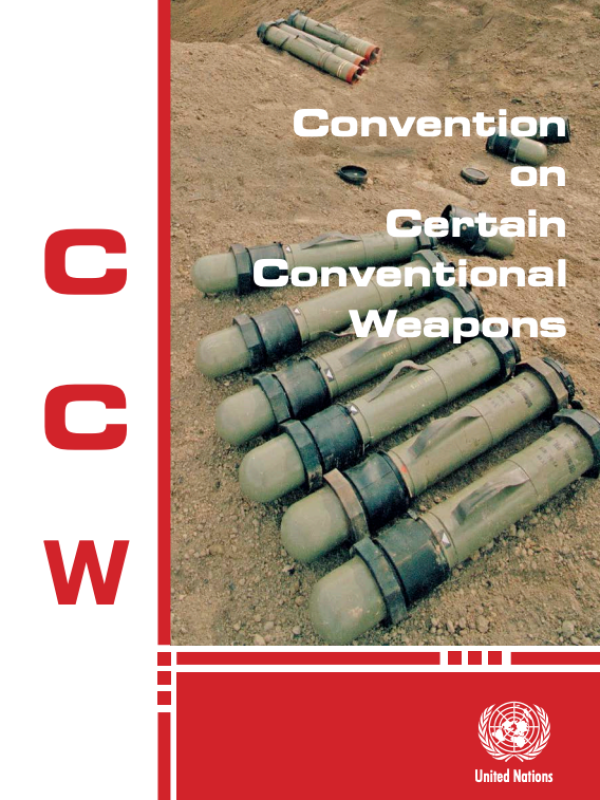
Convention on Certain Conventional Weapons
Armed conflicts are a tragic reality of the world that we live in. However, as set out in the Convention on Certain Conventional Weapons (CCW), conventional weapons that are excessively injurious or whose effects are indiscriminate need not be part of this reality. The CCW is an important instrument of international humanitarian law. A priority of the CCW States Parties is expanding the Convention's membership. Currently there are 118 States Parties to the CCW and the latest country to join is Iraq. This CCW Booklet provides a brief background and history to the Convention and its Protocols, interesting facts on the CCW, information on how States can join and participate in the CCW's meetings, and the mandate of and support provided by the CCW Implementation Support Unit. The booklet is designed to be a guide for those States considering joining the CCW and a useful resource for those working to promote …
Dec 30, 2014
Disarmament and Related Treaties
Treaties are essential to the maintenance of international law and order, and States depend on them to provide stability and consistency in international relations. This publication contains the text of multilateral treaties that focus on nuclear weapons, other weapons of mass destruction, conventional arms, and nuclear-weapon-free zones, all of which are essential for promoting peace and security. It also includes treaties in which disarmament and non-proliferation are important elements within a larger framework of issues, such as the Antarctic Treaty or the Agreement Governing the Activities of States on the Moon and Other Celestial Bodies. The United Nations Office for Disarmament Affairs hopes this book will be a useful tool for diplomats, researchers, those in the service of States parties to the various treaties and conventions, those States not yet parties, and in promoting and furthering the universalization of these …
Dec 4, 2014
Summarizes developments and trends in 2013 on key issues of multilateral consideration at the international and regional levels. Reviews the activity of the General Assembly, the Conference on Disarmament and the Disarmament Commission. Contains a timeline that highlights events in multilateral disarmament in 2013. Has a foreword written by the High Representative for Disarmament Affairs. …
Sep 30, 2014
This report illustrates how the United Nations Office for Disarmament Affairs has been able to achieve concrete results though partnerships with its donors, and how essential such support is in attaining important disarmament goals. …
Jul 31, 2014
The New Zealand Lectures on Disarmament
This Occasional Paper features six lectures delivered in New Zealand in April 2014 by the United Nations High Representative for Disarmament Affairs, Angela Kane. The speeches delve into many of the challenges facing the achievement of a world free of nuclear weapons and provide a comprehensive stocktake of the prospects and challenges confronting disarmament and arms control efforts. She describes both progress, most notably in the field of conventional arms, and a lack of progress, especially as regards nuclear disarmament. The lectures were intended to inspire practical actions and help revive political …
Jun 1, 2014