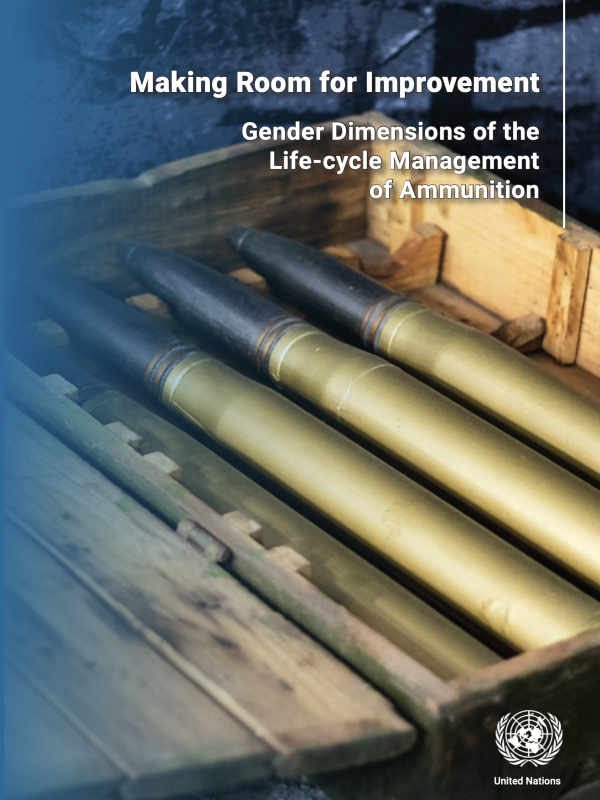
In recent years, the international arms control agenda has become more aligned with that of sustainable development and the Women, Peace, and Security Agenda. As a result, two important synergies have emerged. The first is a focus on disaggregating, assessing, and addressing the various ways in which arms and ammunition impact different stakeholder groups through tools such as gender analysis and the sex disaggregation of data. The second is the need to gender mainstream relevant policies and procedures––that is, to institutionalize meaningful participation in all work processes and structures.
The rationale for these approaches is that they will lead to control efforts that are more equitable for those who do the work and more effective and sustainable for beneficiaries. The UN Secretary-General first drew attention to the importance of these considerations in his Securing our Common Future: An Agenda for Disarmament in 2018, and subsequently in his 2019 Report on Small Arms and Light Weapons.
This paper considers how gender considerations can be conceptualized and addressed in the context of the Life-cycle Management of Ammunition (LCMA). It describes the normative basis for gender mainstreaming LCMA, provides indications of the gender dimensions of ammunition throughout the management of its life cycle, and outlines a framework for promoting further work in this area. It also identifies research questions whose elaboration would advance gender mainstreaming efforts.
A co-publication with the Small Arms Survey. An associated podcast is available at http://www.smallarmssurvey.org/resources/multimedia/podcasts/podcast-51.html.
The 2026 MAPS Dialogues, held on 7 May, 28 May and 10 June, were convened to foster inclusive multilateral discussions ahead of these exchanges. Twelve panelists provided political, technical, legal, and operational expertise across the three sessions.
This report draws the three sessions together into a series report, structured around the agenda of the informal exchanges. Each section opens with the positions articulated by States, and then presents the perspectives developed during the webinars.
This guide supports Member States in the voluntary sharing of information under the Global Framework for Through-life Conventional Ammunition. It includes an overview of the working version of the voluntary national reporting template, as well as a step-by-step walkthrough of the online reporting portal. The Framework aims to strengthen safe, secure and sustainable through-life conventional ammunition management while addressing the dual risks of unplanned conventional ammunition explosions, and the diversion and illicit trafficking of conventional ammunition.
The Convention on Certain Conventional Weapons (CCW) is a central framework for addressing humanitarian concerns arising from the use of specific conventional weapons while balancing legitimate military considerations. The CCW was conceived as a dynamic instrument that can respond to advancements in weapons technology and take into account developments in the nature and conduct of armed conflict, bearing in mind, in the words of its preamble, “the need to continue the codification and progressive development of the rules of international law applicable in armed conflict”.