Displaying 31 - 40 of 64
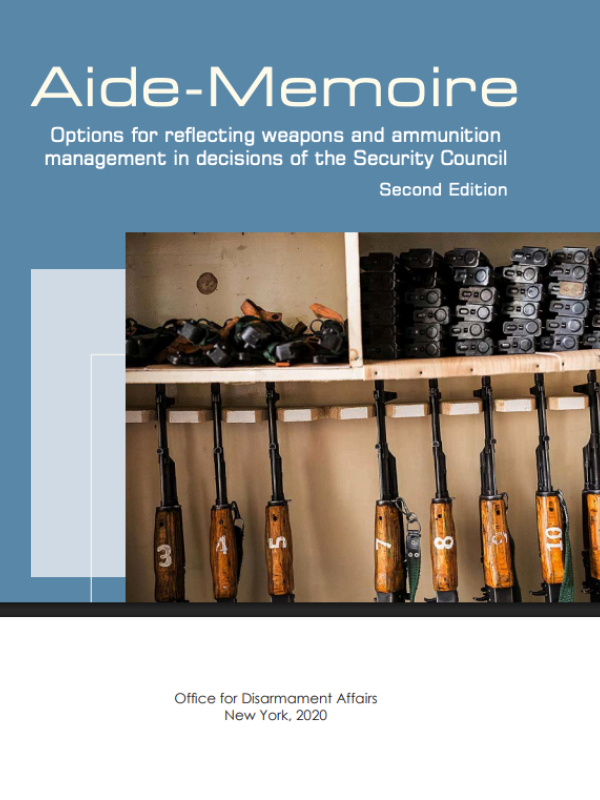
Aide-Memoire: Options for reflecting weapons and ammunition management in decisions of the Security Council
This is the Second Edition of the Aide-Memoire that was originally published in 2018. The content has been updated to reflect the evolution in the Security Council’s practice in addressing weapons and ammunition-related issues from the end of the 1990s through to August 2020. This Second Edition includes a new section highlighting recommendations made by the Secretary-General to support the mainstreaming of weapons and ammunition-related matters in the work of the Security Council derived from previous reports to the Security Council on small arms and light weapons. The main body of the Aide-Memoire (and its supporting Annex 1) is based on a review of more than 650 UN Security Council country-/region-specific and thematic resolutions, and relevant presidential statements issued since the end of the 1990s. A 30-year time frame was used to ensure a broad pool of language options. This time period also corresponds to the establishment of several of the main United Nations peace …
Oct 30, 2020
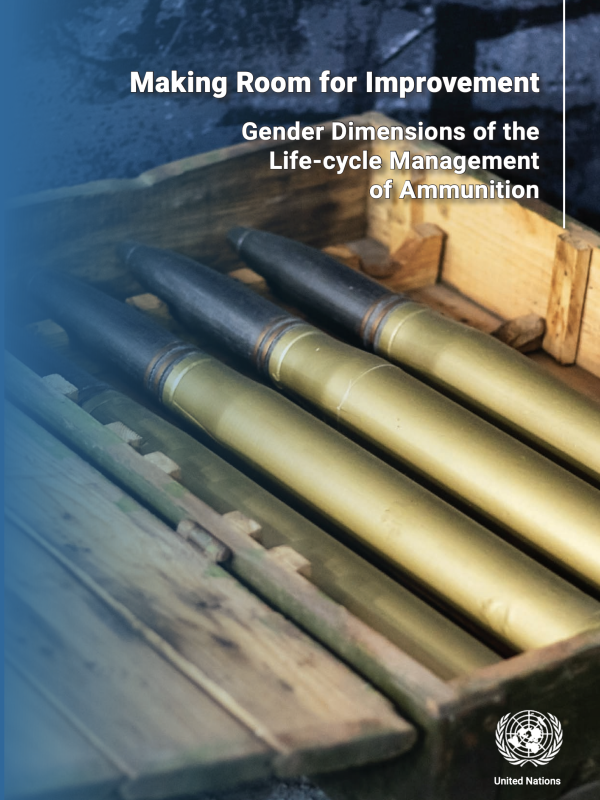
Making Room for Improvement: Gender Dimensions of the Life-cycle Management of Ammunition
In recent years, the international arms control agenda has become more aligned with that of sustainable development and the Women, Peace, and Security Agenda. As a result, two important synergies have emerged. The first is a focus on disaggregating, assessing, and addressing the various ways in which arms and ammunition impact different stakeholder groups through tools such as gender analysis and the sex disaggregation of data. The second is the need to gender mainstream relevant policies and procedures––that is, to institutionalize meaningful participation in all work processes and structures. The rationale for these approaches is that they will lead to control efforts that are more equitable for those who do the work and more effective and sustainable for beneficiaries. The UN Secretary-General first drew attention to the importance of these considerations in his Securing our Common Future: An Agenda for Disarmament in 2018, and subsequently in his 2019 Report on Small Arms and …
Oct 30, 2020
Final Report of the UNODA Project to Identify Lessons Learned from the OPCW-UN Joint Investigative Mechanism
When the OPCW-UN Joint Investigative Mechanism (JIM) was established by Security Council resolution 2235 in August 2015, it was given the mandate to identify, to the greatest extent feasible, the perpetrators of the use of chemicals as weapons in the Syrian Arab Republic. The JIM’s mandate for attribution of responsibility was a unique undertaking in the context of past efforts by both the United Nations and the OPCW to investigate allegations of the use of chemical weapons. Accordingly, after the expiration of the JIM’s mandate in 2017, there was interest in conducting a lessons-learned exercise to distill the lessons from the experience of the JIM, as is frequent practice within the United Nations after the conclusions of missions and programmes. UNODA was fortunate to receive support for a lessons-learned project from the Governments of Canada and Switzerland, whose generous financial contributions made the project possible. UNODA is pleased to share the final report of the JIM …
Oct 6, 2020
The Militarization of Artificial Intelligence
Artificial Intelligence (AI) has the potential to improve the health and well-being of individuals, communities, and states, and help meet the UN’s Sustainable Development Goals. However, certain uses of AI could also undermine international peace and security by raising concerns about safety and security of the technology, accelerating the pace of armed conflicts, or loosening human control over the means of war. In 2019, the United Nations Office for Disarmament Affairs, the Stanley Center and the Stimson Center partnered in a workshop and series of papers to facilitate a multistakeholder discussion among experts from Member States, industry, academia, and research institutions, with the aim of building understanding about the peace and security implications of AI. This publication captures that conversation and shares assessments of the topic from US, Chinese, and Russian perspectives. It is intended to provide a starting point for more robust dialogues among diverse communities …
Jun 3, 2020
Utilizing the International Ammunition Technical Guidelines in Conflict-Affected and Low-Capacity Environments (UNIDIR publication)
The Utilizing the International Ammunition Technical Guidelines in Conflict-Affected and Low-Capacity Environments guide offers practical information and guidance on how basic ammunition stockpile safety and security can be improved and risks reduced in ammunition storage and processing facilities in conflict-affected and low-capacity environments extracting essential elements from the IATG. This guide was developed by the United Nations Institute for Disarmament Research (UNIDIR), a key research partner of the UN SaferGuard …
Mar 30, 2019
A Guide to Developing National Standards for Ammunition Management
This guide is published by the UN SaferGuard Programme as a practical support guide for applying the International Ammunition Technical Guidelines (IATG). It aims to assist State authorities in the development of national standards for ammunition management based on IATG and towards implementing those standards across State institutions. More specifically, it outlines the key considerations and processes involved in the development of national standards and provides advice for the development of an organizational framework necessary for an effective, coordinated and sustainable national ammunition management …
Mar 30, 2019
Critical Path Guide to the International Ammunition Technical Guidelines
The Critical Path Guide is published by the UN SaferGuard Programme as a practical support guide for applying the International Ammunition Technical Guidelines (IATG). It clarifies how the measures within the IATG are to be interpreted and applied in practice and explains technical concepts and processes in a simple, clear, and concise manner. It supports users in navigating the principles, methodology and technical content of the IATG. …
Mar 30, 2019
Hypersonic Weapons: A Challenge and Opportunity for Strategic Arms Control
A Study Prepared on the Recommendation of the Secretary-General’s Advisory Board on Disarmament Matters
The pursuit by several nuclear-armed States of novel long-range strike options has received little attention in multilateral disarmament discussions despite their potentially negative implications for security, arms control and disarmament. This study aims to raise awareness of these implications and to consider possible ways to address them in a multilateral context. It includes overviews of: the current state of technology; possible implications for international peace and security; possible implications for existing and future arms control and disarmament efforts; and different approaches States may pursue to address these …
Feb 28, 2019
Aide-Memoire: Options for reflecting weapons and ammunition management in decisions of the Security Council
This publication conveniently clusters past Security Council action regarding weapons and ammunition management and suggests further options. It seeks to assist particularly those Member States serving on the Security Council, in accurately and comprehensively reflecting state-of-the-art practices into relevant drafts of the Council’s decisions. The publication also supports the recommendation of the Secretary-General, in his report to the Security Council on small arms from 2015, that the arms situation be consistently considered when addressing both geographic and thematic issues on its agenda (S/2015/289). This Aide-Memoire was developed by the UN Office for Disarmament Affairs. Drafts were helpfully reviewed by United Nations system partners including the UN Institute for Disarmament Research (UNIDIR), the UN Department of Political Affairs (DPA), and the UN Department of Peacekeeping Operations (DPKO). Additional consultations with policy experts and those involved in weapons and …
Oct 30, 2018
How weapons control fosters development
The 2030 Agenda for Sustainable Development places disarmament, arms regulation, peace and security squarely within the scope of development policies, by including a target to significantly reduce illicit arms flows. Disarmament and arms regulation are also deeply relevant for reaching other Goals, from gender equality, safe and sustainable cities, to quality education. The infographic summarizes the contributions disarmament and arms regulation can make towards achieving many Goals of the 2030 Agenda. Dimensions : 17″ x …
Jul 30, 2018